Overview
Scala Apps provide numerous templates that help you quickly create content for common playback needs. For general information about how Scala Apps work, refer to Learn About Scala Apps.
Included in the Scala App templates is the Google Calendar / iCal template. The Google Calendar / iCal template lets you show the current day's events on your display screens, which are automatically imported from a calendar that is external to your Scala environment, such as from a Google Calendar. For example, if you have a conference room that is used for various different meetings every day, you could enter those meetings in a Google Calendar and then use this template so that each day's agenda of meetings is automatically shown on a display screen that is mounted near the door to that conference room.
The event information that appears on your display screens automatically updates whenever the information in the external calendar is changed. Only the calendar events that are scheduled for the current day are displayed, and an event is automatically removed from your display screen once the event has ended.
In addition to Google Calendar, you can link this Scala App to any iCal formatted calendar file, as long as you can provide a URL where the file can be accessed without any authentication required.
There are Google Calendar / iCal templates available in both a portrait and landscape orientation. You should use a template with the orientation that matches how your display screens are mounted.
To use this Scala App, your players must have internet access.
If you want to show events on your display screens from a Microsoft Office 365 calendar, use the 0365 Calendar template.
Demo
Play the video below for an example of the Google Calendar / iCal template put into use.
Using the Google Calendar / iCal Template
Follow the steps below to use the Google Calendar / iCal template to create a message. Messages are the filled in templates that become autonomous media items which can be added to playlists. This means that once created, a message is no longer tied to the template, but still maintains the template properties.
After you create a message, you can find it in your media list and edit it at any time. For example, you can update the heading or images that appear on the message, and the changes will be automatically applied to that message in every playlist where it exists.
Click the main menu

In the menu, select Templates under Scala Apps. The App Templates page opens.
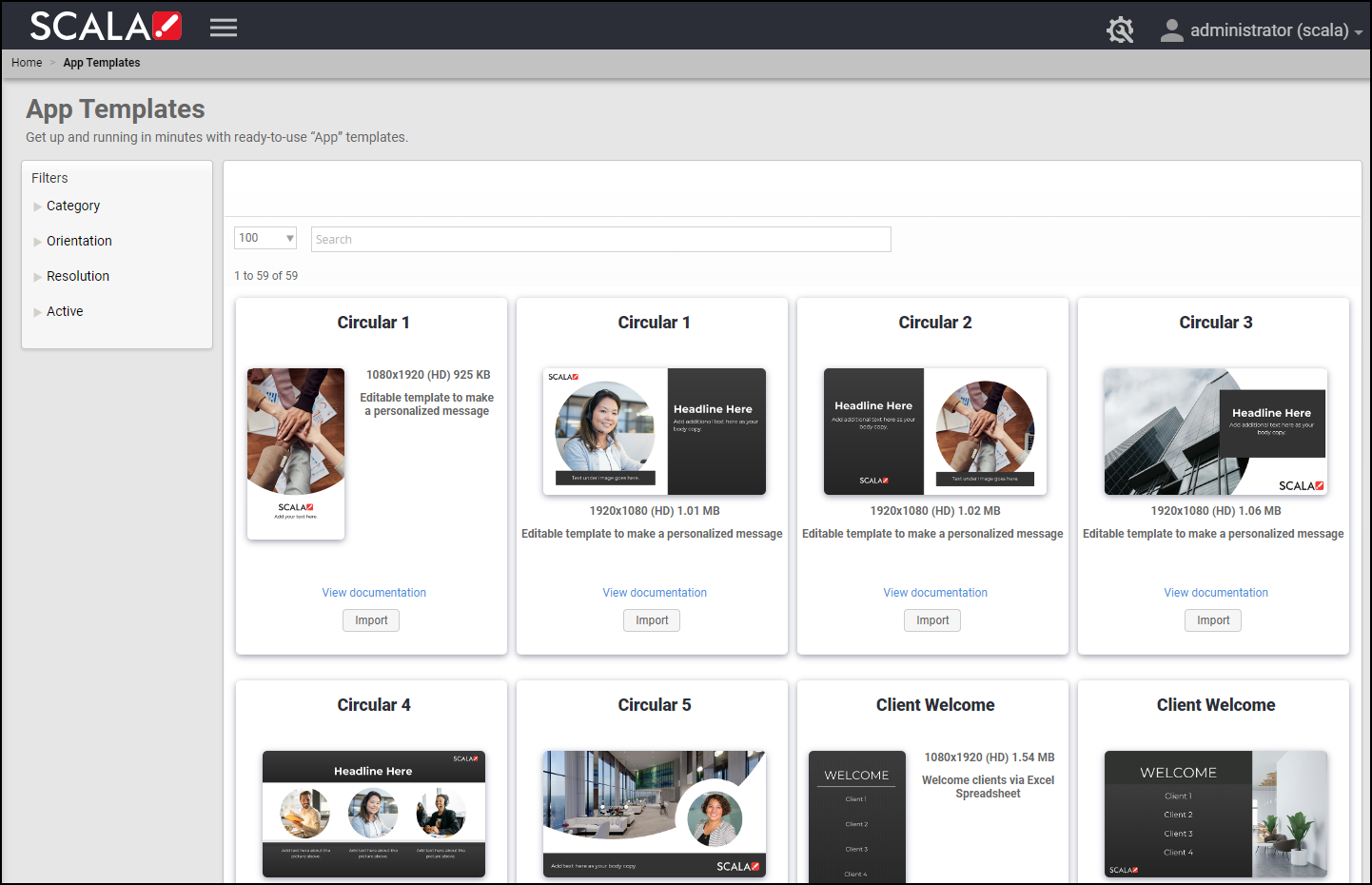
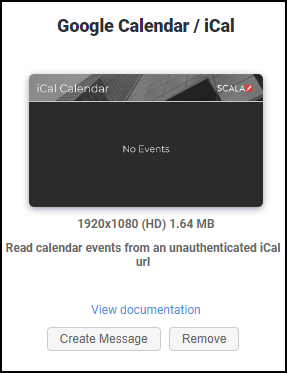
Find the Google Calendar / iCal template that you want to use. Click the Create Message button.
Make sure to choose a template in the correct orientation, either portrait or landscape, based on how your display screens are mounted.
If an Import button appears instead of Create Message, it means that the template does not yet exist on your system. Click the Import button to import the template on to your system. Once the import is successfully completed, the Creating New Message window appears. If you host Content Manager on-premise, your Content Manager server must have internet access in order to import Scala App templates (the server must be able to access www.apps.scala.com).
The Creating New Message window opens.
In the Name field, enter a name for the message.
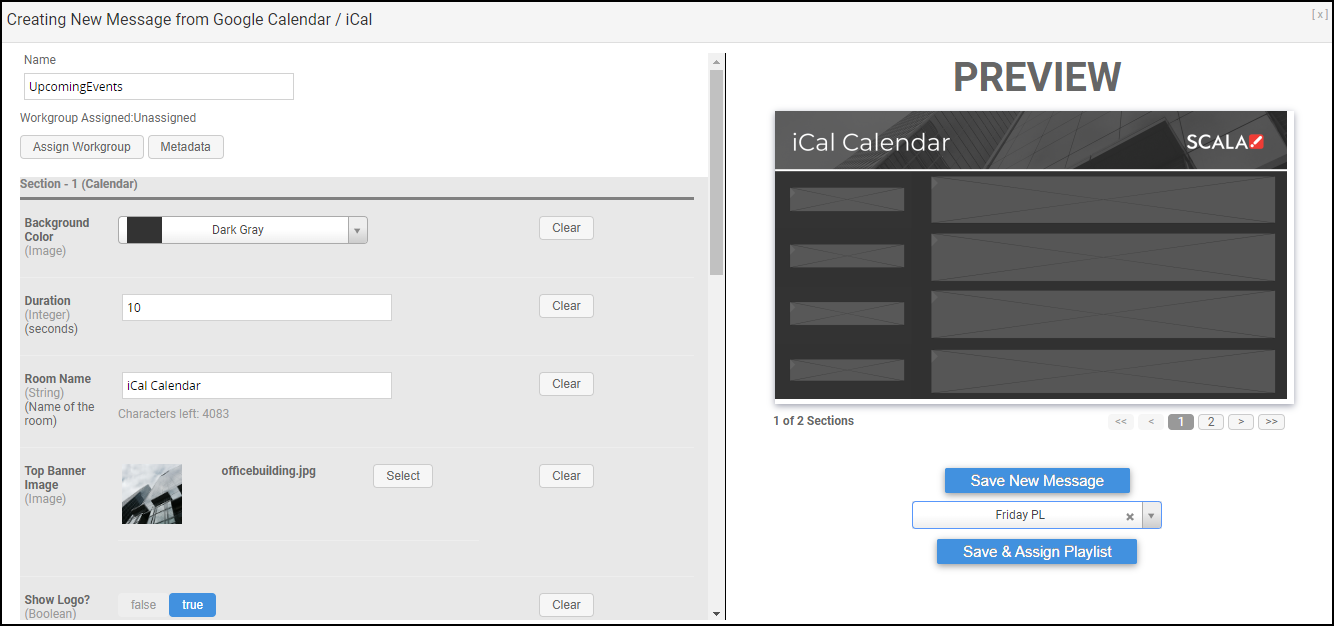
If you want to assign the new message file to workgroups, click the Assign Workgroup button. Assign an Owner workgroup and Shared workgroups as appropriate.
If a user belongs to the owner workgroup, the user can view, edit, and delete the entity.
If a user belongs to the shared workgroup, the user can view and use the entity, but not edit nor delete it.
If a user does not belong to any of the workgroups, the entity is hidden from the user.
If the entity is not assigned to any workgroup, all users can view, edit, and delete it (dependent on each user's role permissions).
Additionally, workgroup restrictions are enforced between entities in Content Manager. For example, if a playlist belongs to a certain workgroup, a media item must also belong to the same workgroup to be added to that playlist. Read more.
If you want to set metadata values for the message, click the Metadata button and complete the metadata fields as desired. The metadata fields that are available reflect the media metadata that was created by your organization. Adding metadata values to the message allows it to be added to smart playlists. While regular playlists require you to add and remove media items manually, smart playlists are populated with media automatically based upon matching metadata criteria.
The Metadata button appears only if you are using Content Manager version 13.20 or newer. If you are using an older version, you can add metadata values to the message after you save it by opening the message's properties.
The remaining options appear in a different sequence depending on which Google Calendar / iCal template you are using.
In the Background Color field, select the background color that you want to appear on the message.
In the Duration field, enter the number of seconds that you want the message to appear on screen before switching to the next media item in the playlist.
In the Room Name field, enter the text that you want to appear at the top of the message. If you are displaying the calendar for a certain room, you might enter the name of that room.
In the Top Banner Image field, click the Select button if you want to choose a different image that appears on the message. The image that you want to use must be uploaded in Content Manager, using the same process that you would to upload any media item, so that it exists in your media list.
In the Show Logo? field, select Yes if you want the Logo image to appear. Select No if you do not want any logo to appear on the message at all.
In the Logo field, click the Select button to change the logo image that appears. The image that you want to use must be uploaded in Content Manager, using the same process that you would to upload any media item, so that it exists in your media list.
In the iCal URL field, enter the URL where the iCal calendar file that you want to link to is located. The iCal file provides the event information that appears on your display screens. The iCal file must be accessible without authentication (without requiring a username and password).
If you want to link to a Google Calendar, click here for the steps you need to follow to find the Google URL that you need to enter.
In the right pane:
If you want to save the message without adding it to a playlist, click the Save New Message button. The message will be available in the media list, so that you can add it to any playlists at any time.
If you want to save the message and also add it to a particular playlist, choose a playlist in the Select Playlist field, then click the Save & Assign Playlist button. In addition to adding the message to the playlist that you chose, the message will be available in your media list, so that you can add it to any other playlists at any time.